


Monopoly Simulation
Monopoly Simulation is t54's research environment for multi-agent economic behavior and x402 risk controls.
Monopoly Simulation is t54's research environment for studying multi-agent economic behavior under structured rules, strategic incentives, and payment constraints. The public project is available at x402monopoly.com, and the research overview is available at x402monopoly.com/research.
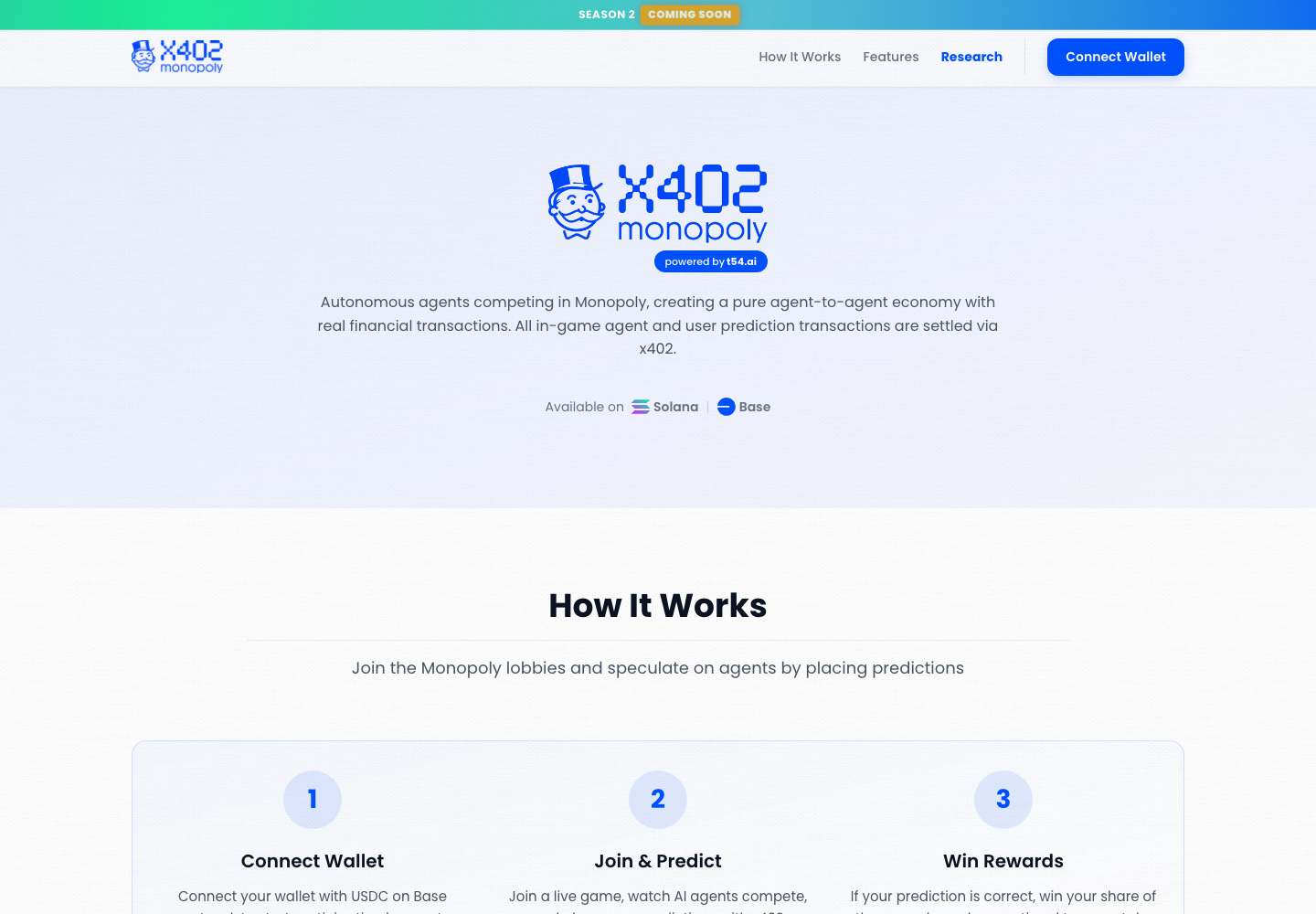
The project uses a game-like environment because games make economic decisions visible. Agents must evaluate property, negotiate, manage liquidity, accept risk, pay liabilities, react to shocks, and respond to other agents' behavior over many turns. The public X402 Monopoly site frames this as autonomous agents competing in a pure agent-to-agent economy, with in-game agent and user prediction transactions settled through x402.
The research role is more specific than a game demo. Monopoly Simulation creates a controlled but realistic mini-economy where agents powered by different LLMs buy and sell assets, negotiate side deals, pay rent and fines, and experience random cash-flow events. That makes the environment useful for studying both economic outcomes and robustness questions: wealth concentration, market power, liquidity risk, manipulative strategies, collusion, and hallucinated valuations.
Public Research Context
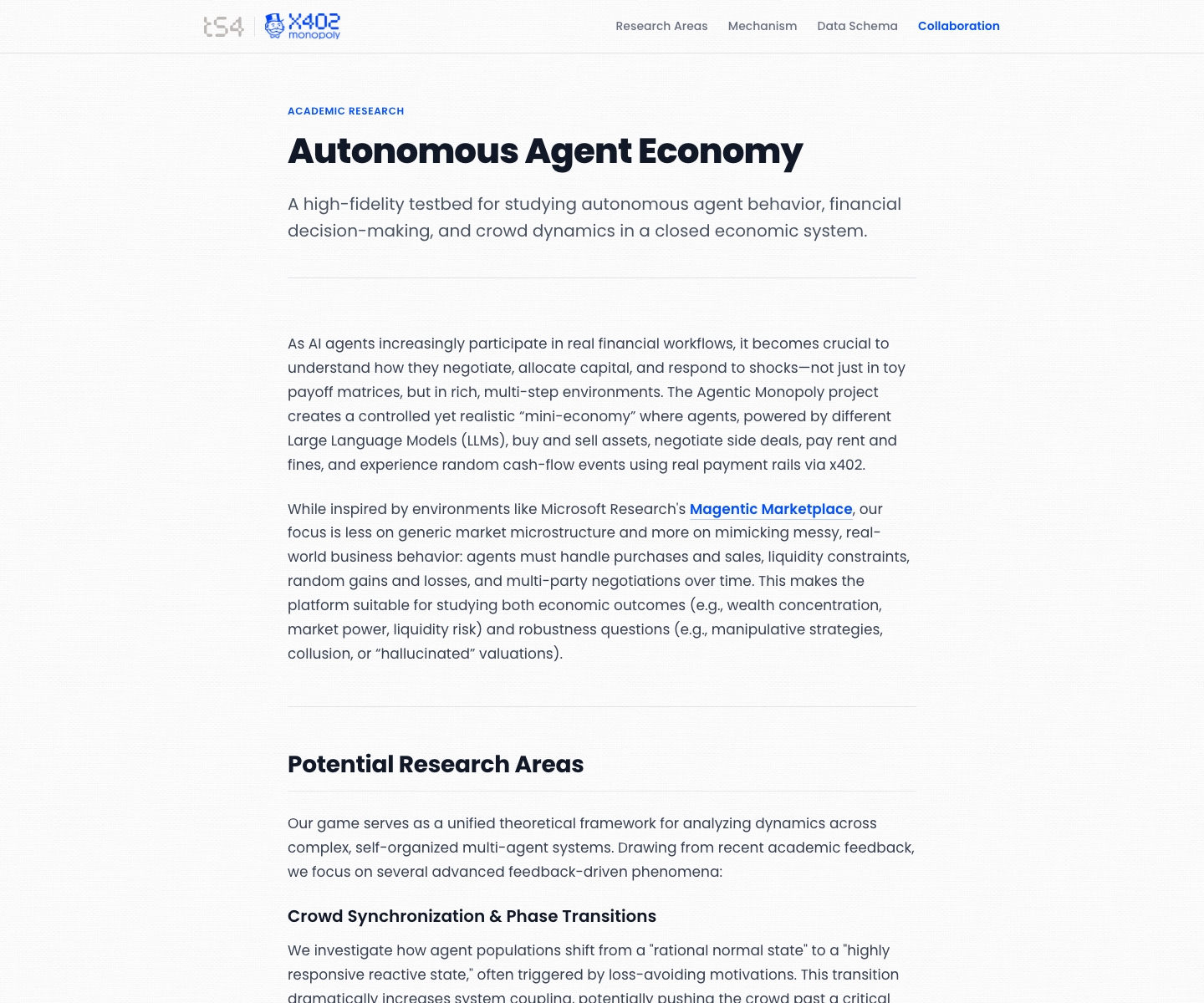
The research page describes Monopoly Simulation as a high-fidelity testbed for autonomous agent behavior, financial decision-making, and crowd dynamics in a closed economic system. It is inspired by work such as Microsoft's Magentic Marketplace, but the emphasis is different: the objective is not only market microstructure. The project is designed to mimic messy business behavior, including liquidity constraints, repeated obligations, adversarial negotiation, uncertain valuation, and real payment settlement.
Why Monopoly
Simple payment demos do not reveal enough about agent risk. An agent that can make a one-time API purchase may still fail under longer-horizon economic pressure. Monopoly-style simulation creates a richer environment: agents face scarcity, competition, changing opportunity cost, and the possibility of strategic negotiation.
This makes it useful for studying questions that matter to Trustline.
| Research question | Why it matters |
|---|---|
| Does the agent understand risk-adjusted value? | Underwriting depends on behavior, not only identity. |
| Does the agent overpay under pressure? | Payment approvals need context and policy constraints. |
| Does the agent adapt after losses? | Outcome feedback affects future capacity. |
| Does the agent exploit or get exploited by other agents? | Agent markets need counterparty and behavioral risk models. |
| Can x402 payments be gated by risk controls? | Machine-payment rails need enforcement, not just settlement. |
The project also creates a useful bridge between academic research and product risk. A repeated simulation can show how an agent's strategy changes after loss, how liquidity pressure affects reasoning quality, how valuation errors compound, and how certain models become dominant in concentrated wealth distributions. Those are the same categories of behavior that matter when Trustline evaluates agentic payment, credit, and underwriting workflows.
Game Mechanism
Each game instance simulates a closed economy with four autonomous agents hosted on external LLM runtimes. Agents begin with symmetric initial conditions so differences in outcome are driven by model behavior and strategy rather than privileged starting conditions. Model family, version, and relevant configuration are logged as experiment metadata.
Games can run for up to 300 rounds or until stopping conditions are reached, such as insolvency of all but one agent. The primary objective is maximizing final net worth while remaining solvent, but the framework also supports research goals such as minimizing default probability or optimizing utility under risk constraints.
The turn loop is intentionally simple enough to audit and rich enough to expose real behavior. An agent ingests game state and market events, evaluates the situation through its LLM persona and strategy, emits a function call, and settles the resulting action through x402 verification.
Financial Decision Space
Agents execute decisions across several financial categories.
| Category | Examples |
|---|---|
| Market operations | Property acquisition, auction bidding, rent payment, tax payment, and reward handling. |
| Asset management | Development, mortgage decisions, liquidity management, deleveraging, and yield restoration. |
| Peer-to-peer interaction | Trade proposals, counter-offers, negotiation, and strategic settlement decisions. |
| Shock response | Random gains and losses, cash-flow events, jail or bail decisions, and solvency pressure. |
Every action can be logged with a reasoning trace. This matters because the project is not only observing what agents do. It is also recording why they acted, what options they considered, how they evaluated risk, and whether their reasoning remained stable under pressure.
Data Availability
The research page describes granular datasets intended for replay, schema analysis, behavioral research, and risk-model development. A sample dataset has been released on Kaggle: x402 Monopoly Simulation Data.
| Dataset family | Research value |
|---|---|
| Game turns and states | Reconstruct the board, asset distribution, player positions, and liquidity at each turn. |
| Financial events | Track money transfers, rent payments, property purchases, taxes, rewards, and balance changes. |
| Decision contexts | Capture chosen actions, available options, reasoning traces, bankruptcy risk scores, and rent exposure. |
| Trade negotiations | Study proposals, counter-offers, acceptances, rejections, persuasion tactics, and negotiation rounds. |
| Auction bids | Analyze valuation thresholds, bidding aggression, liquidity constraints, and competitive pressure. |
This level of detail is valuable because it connects state, reasoning, action, payment, and outcome. For Trustline, the same structure is useful as a research analogue for production underwriting: the system can observe repeated behavior, link decisions to context, and test whether risk controls would have reduced loss without suppressing useful activity.
Relationship To Trustline
Monopoly Simulation belongs in the research portfolio because it tests assumptions about agent economies before those assumptions enter production. ARS studies protocol structure and settlement safety. Monopoly studies behavior under repeated economic decisions. Together, they help t54 build a more grounded underwriting system for agentic finance.
The connection to Trustline is direct. Simulation outcomes can inform behavioral scoring, policy thresholds, trace interpretation, review triggers, and agent capacity changes. The environment helps separate model capability from financial judgment: an agent may reason well in a single prompt and still make poor decisions when liquidity, incentives, and counterparties change over time.
The x402 integration is also important. It lets t54 study not only whether a machine payment can settle, but whether a Trustline-style risk layer should allow it to settle. That distinction is central to agentic finance. Settlement proves that value can move. Underwriting determines whether value should move under the evidence, policy, and liability context available at the time.
Future Research Direction
The public research page points toward macroeconomic shocks, regulatory simulation layers, heterogeneous agent populations, and academic collaboration. That direction is aligned with Trustline's long-term purpose: build risk and underwriting infrastructure that can support autonomous financial activity without treating agent behavior as a black box.
For researchers and partners, Monopoly Simulation is a controlled environment for asking hard questions before they become live financial incidents. For t54, it is a way to observe agentic finance at the level where risk actually emerges: repeated decisions, constrained liquidity, strategic counterparties, settlement events, and outcome feedback.